Panoramic (PDFs, Resources)
Level A2
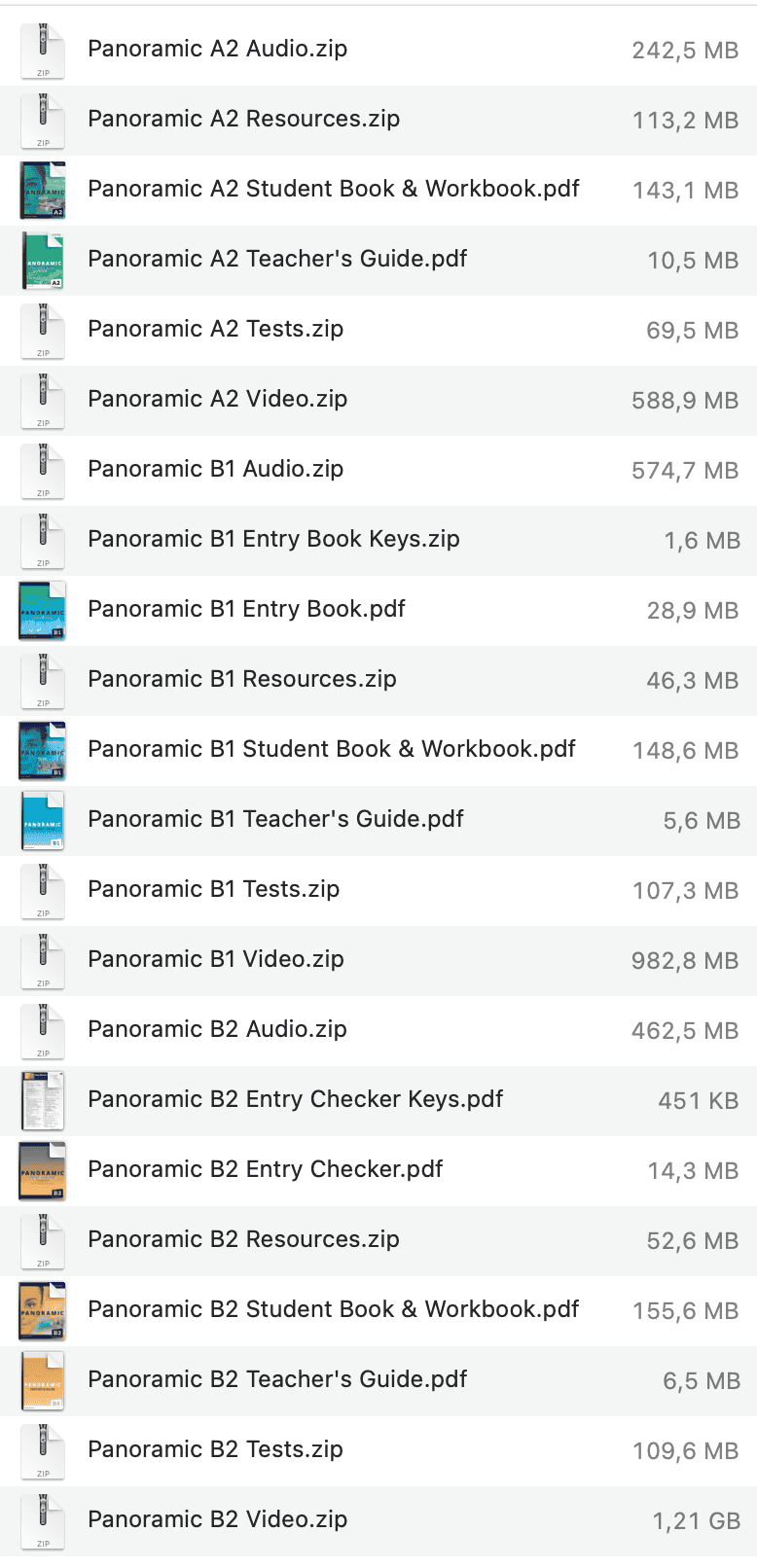
Panoramic A2 Audio.zip
Panoramic A2 Resources.zip
Panoramic A2 Student Book & Workbook.pdf – Sample: Click
Panoramic A2 Teacher’s Guide.pdf
Panoramic A2 Tests.zip
Panoramic A2 Video.zip
Level B1
Panoramic B1 Audio.zip
Panoramic B1 Entry Book Keys.zip
Panoramic B1 Entry Book.pdf – Sample: Click
Panoramic B1 Resources.zip
Panoramic B1 Student Book & Workbook.pdf – Sample: Click
Panoramic B1 Teacher’s Guide.pdf
Panoramic B1 Tests.zip
Panoramic B1 Video.zip
Level B2
Panoramic B2 Audio.zip
Panoramic B2 Entry Checker Keys.pdf
Panoramic B2 Entry Checker.pdf – Sample: Click
Panoramic B2 Resources.zip
Panoramic B2 Student Book & Workbook.pdf – Sample: Click
Panoramic B2 Teacher’s Guide.pdf
Panoramic B2 Tests.zip
Panoramic B2 Video.zip
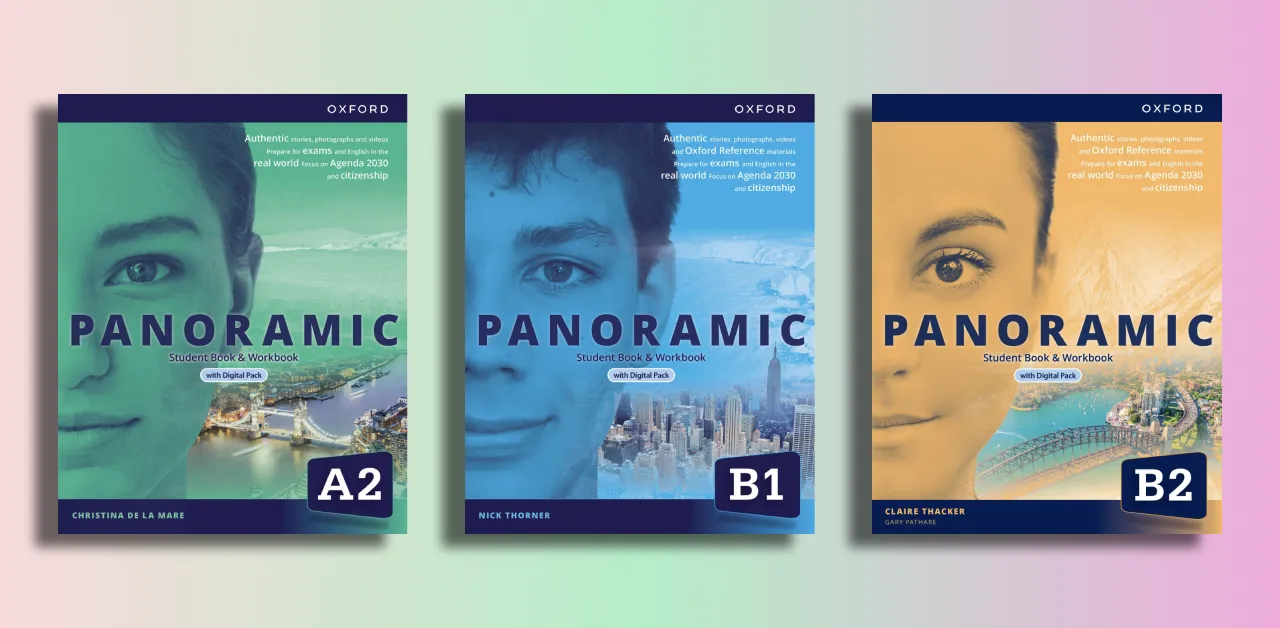
Giới thiệu “Panoramic” của Oxford
| ✅ Bộ giáo trình: | Panoramic |
| ✅ Nhà xuất bản: | Oxford University Press |
| ✅ Levels: | A2, B1, B2 |
| ✅ Ngôn ngữ: | American English |
| ✅ Dành cho: | Secondary, High School |
| ✅ Năm xuất bản: | 2022 |
Panoramic by Oxford University Press is a contemporary English course designed to help upper-secondary learners develop the language, confidence, and broader competencies required for education, examinations, work, and life beyond the classroom. Covering CEFR levels A2, B1, and B2, the series combines systematic language instruction with meaningful communication, global topics, mediation activities, and transferable skills.
This combination of linguistic accuracy, intellectual engagement, and real-world communication makes Panoramic especially relevant to modern secondary education.
What Is Panoramic by Oxford?
Panoramic is a three-level English language course published by Oxford University Press. It is primarily intended for teenage and upper-secondary learners progressing from elementary to upper-intermediate proficiency.
- Panoramic A2: Elementary
- Panoramic B1: Intermediate
- Panoramic B2: Upper-intermediate
Across the three levels, students gradually expand their grammar, vocabulary, pronunciation, receptive skills, productive skills, and ability to communicate independently. The progression is structured around the Common European Framework of Reference for Languages, providing learners and teachers with recognizable proficiency goals.
The course also reflects a broader view of language education. English is presented not merely as a school subject, but as a means of participating in discussions, interpreting information, solving problems, and communicating across cultures.
A CEFR-Aligned Learning Pathway
One of the strongest foundations of Panoramic is its clearly organized language syllabus. The grammar syllabus is aligned with the CEFR through the Oxford English Learning Framework, which provides a research-informed structure for language progression.
This alignment helps ensure that grammar is introduced at an appropriate stage and developed systematically. New structures are usually presented in meaningful contexts before students examine how they work and apply them in controlled and communicative activities.
Rather than treating grammar as a collection of isolated rules, Panoramic connects grammatical knowledge with practical language use. Students learn not only how a structure is formed, but also when and why it is used in communication.
The CEFR-based organization is valuable for schools and language centers because it supports:
- clear placement and progression between levels;
- measurable learning objectives;
- consistent course planning;
- preparation for internal and external assessments;
- greater transparency for students, teachers, and parents.
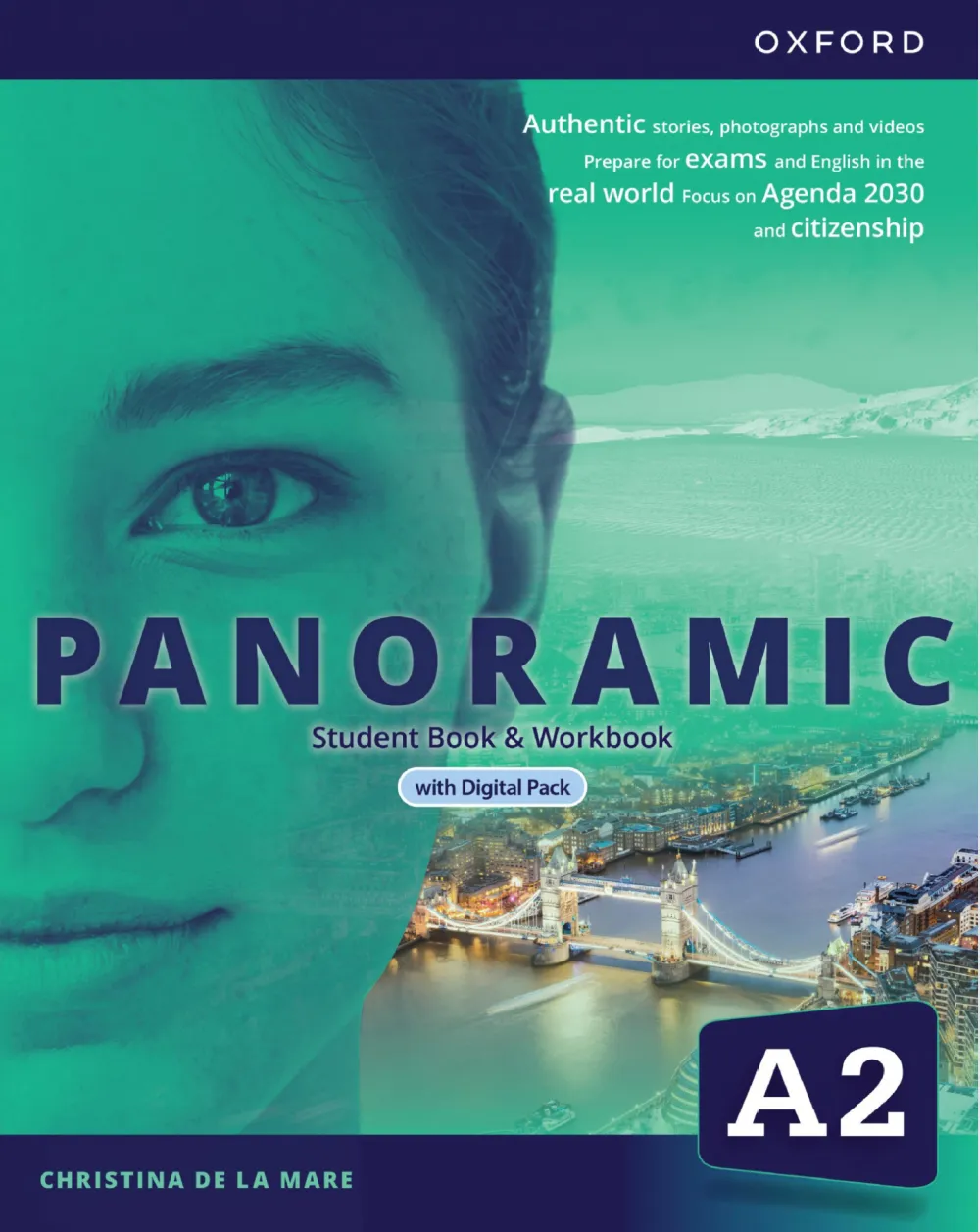
Panoramic A2 Student Book & Workbook
Vocabulary Based on the Oxford 3000 and Oxford 5000
Vocabulary development is another significant feature of the series. Panoramic draws on the Oxford 3000 and Oxford 5000, carefully selected lists of high-value words that English learners need for effective communication.
This approach allows students to focus on vocabulary with genuine usefulness rather than spending excessive time on rare or highly specialized items. Words are introduced through relevant topics and reinforced through reading, listening, speaking, writing, and review activities.
Students are encouraged to understand more than the basic meaning of a word. They also develop awareness of pronunciation, word families, collocations, grammatical patterns, and context. This deeper lexical knowledge supports more natural communication and improves both comprehension and production.
Contemporary Topics That Encourage Meaningful Thinking
Panoramic uses current, age-appropriate themes to connect classroom learning with the experiences and concerns of young people. Topics are selected not only for their linguistic value, but also for their ability to generate curiosity, reflection, and discussion.
Students may explore subjects related to identity, society, culture, science, technology, education, communication, the environment, and future possibilities. Instead of presenting every subject from a single angle, the course frequently invites learners to compare perspectives and consider how different people may interpret the same issue.
This perspective-based approach gives students a genuine reason to communicate. Speaking and writing become opportunities to formulate an idea, respond to evidence, explain a position, or engage with another person’s viewpoint.
As a result, language practice becomes more purposeful. Students are not simply producing English to complete an exercise; they are using English to make meaning.
360-Degree Student Engagement
Oxford describes Panoramic as providing 360-degree student engagement. In practice, the course attempts to involve learners on several levels: linguistic, cognitive, visual, social, and emotional.
Lessons combine varied forms of input and interaction, including texts, audio, video, images, individual reflection, pair work, group discussion, problem-solving, and extended production. This variety helps prevent lessons from becoming repetitive and gives students with different learning preferences more opportunities to participate successfully.
Engagement is not treated as entertainment alone. Activities are designed to direct students toward meaningful learning outcomes. A visually interesting page, for example, may introduce a theme, activate background knowledge, prepare learners for a listening task, or provide evidence for a classroom discussion.
This balance between interest and academic purpose is particularly important for teenage learners, who often respond best when lesson content feels relevant but still provides a clear sense of progress.
Developing All Four Language Skills
Panoramic provides integrated development of reading, listening, speaking, and writing. Skills are connected within the wider context of each unit rather than taught as completely separate areas.
Reading
Reading activities expose students to different text types and help them develop strategies such as predicting content, identifying main ideas, locating specific information, understanding reference, interpreting vocabulary from context, and recognizing the writer’s purpose.
Listening
Listening materials help learners process spoken English in a range of situations. Students practise listening for general meaning and detailed information while becoming more familiar with natural pronunciation, connected speech, and different speaking styles.
Speaking
Speaking tasks move from guided preparation toward increasingly independent communication. Pair and group activities encourage students to share experiences, discuss opinions, negotiate decisions, solve problems, and deliver more extended spoken responses.
Writing
Writing instruction supports students through planning, organization, useful language, model analysis, drafting, and revision. Learners gradually build the ability to produce clear and appropriate texts for different purposes and audiences.
Because the four skills are integrated, language encountered in a reading or listening text can later be recycled in a speaking or writing task. This creates stronger connections between input, practice, and independent production.
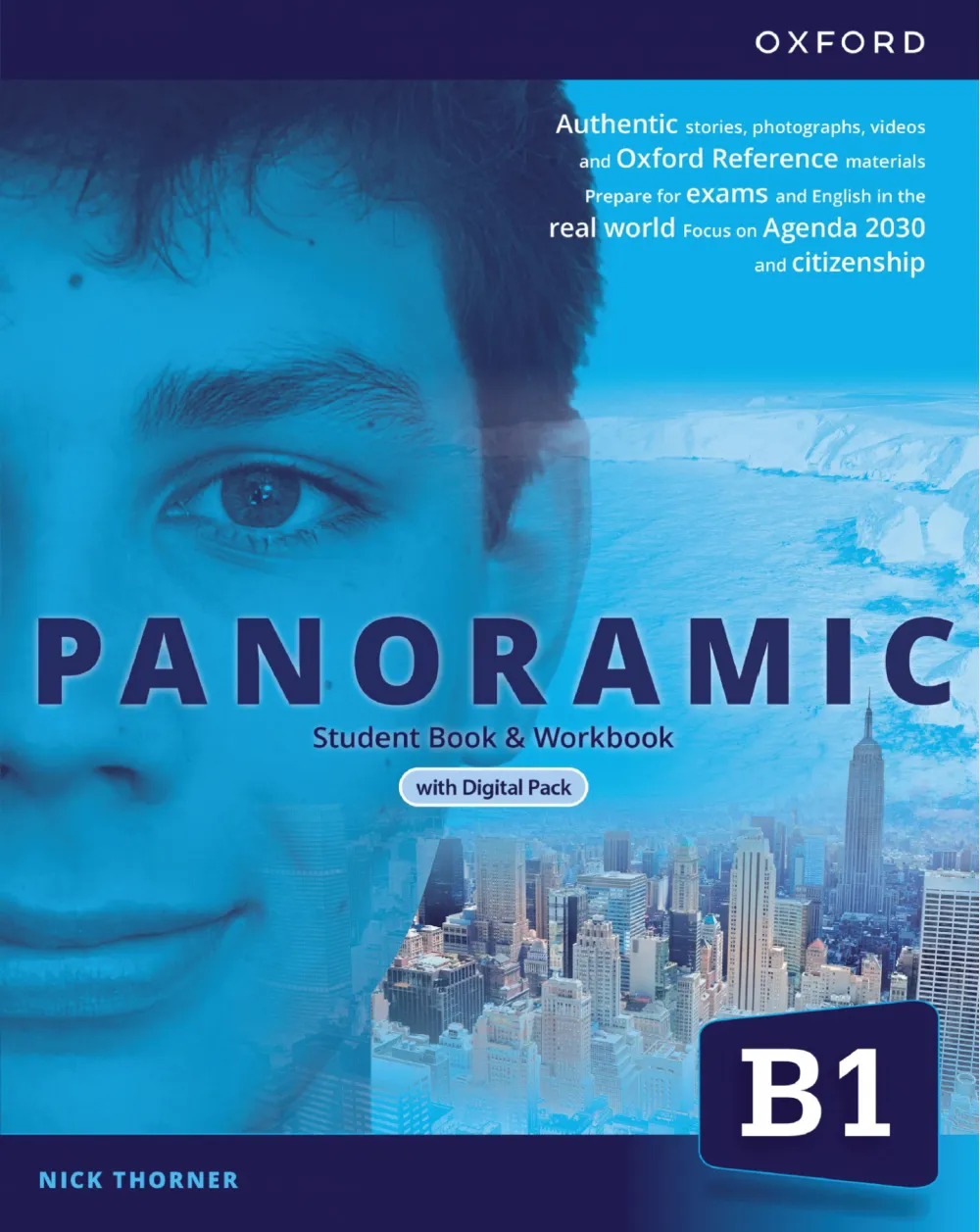
Panoramic B1 Student Book & Workbook
Mediation as a Core Communication Skill
A particularly modern feature of Panoramic is its emphasis on mediation. In language education, mediation involves helping other people understand information, ideas, or viewpoints. It may include summarizing a text, explaining a concept in simpler language, reporting the main points of a discussion, interpreting visual information, or helping people reach a shared understanding.
These tasks reflect how English is often used outside the classroom. In international study and work environments, speakers frequently need to communicate information between people rather than simply express their own personal message.
Mediation activities can help students develop:
- active listening and careful reading;
- summarizing and paraphrasing;
- awareness of audience and purpose;
- clarification and explanation;
- cooperation and negotiation;
- respect for different perspectives.
By integrating mediation into ordinary language lessons, Panoramic prepares students for more complex and realistic forms of communication.
Transferable Skills for Study, Work, and Life
Language proficiency is essential, but successful learners also need skills that can be transferred to other subjects and future situations. Panoramic therefore connects English learning with broader competencies such as critical thinking, collaboration, creativity, communication, organization, and independent learning.
Students may be asked to compare sources, identify evidence, evaluate alternatives, organize information, contribute to a group task, or present a reasoned conclusion. These activities help learners become more active participants in the educational process.
From a pedagogical perspective, this is an important strength. Students are learning English while simultaneously practising how to think, interact, and work more effectively.
Grammar Support Without Losing Communication
Communicative courses sometimes provide engaging topics but insufficient grammatical depth. More traditional courses may offer extensive grammar practice without enough meaningful interaction. Panoramic seeks to balance these two priorities.
The series provides a comprehensive grammar syllabus supported by explanations, examples, practice, recycling, and review. At the same time, grammar is repeatedly connected with speaking and writing outcomes.
This means learners can develop both accuracy and fluency. They gain the structural knowledge needed for examinations and formal writing while also learning to retrieve and use that knowledge during real communication.
Preparation for Examinations and Academic Progress
Panoramic supports students preparing for school assessments and external English examinations. Learners encounter common task formats, structured skills practice, revision activities, and opportunities to apply language under increasingly demanding conditions.
However, the course is broader than a conventional test-preparation program. Exam skills are integrated into a complete language-learning pathway. Students develop the underlying grammar, vocabulary, comprehension, and communication abilities that assessments are intended to measure.
This approach can produce more sustainable progress than training students to rely on test-taking techniques alone.
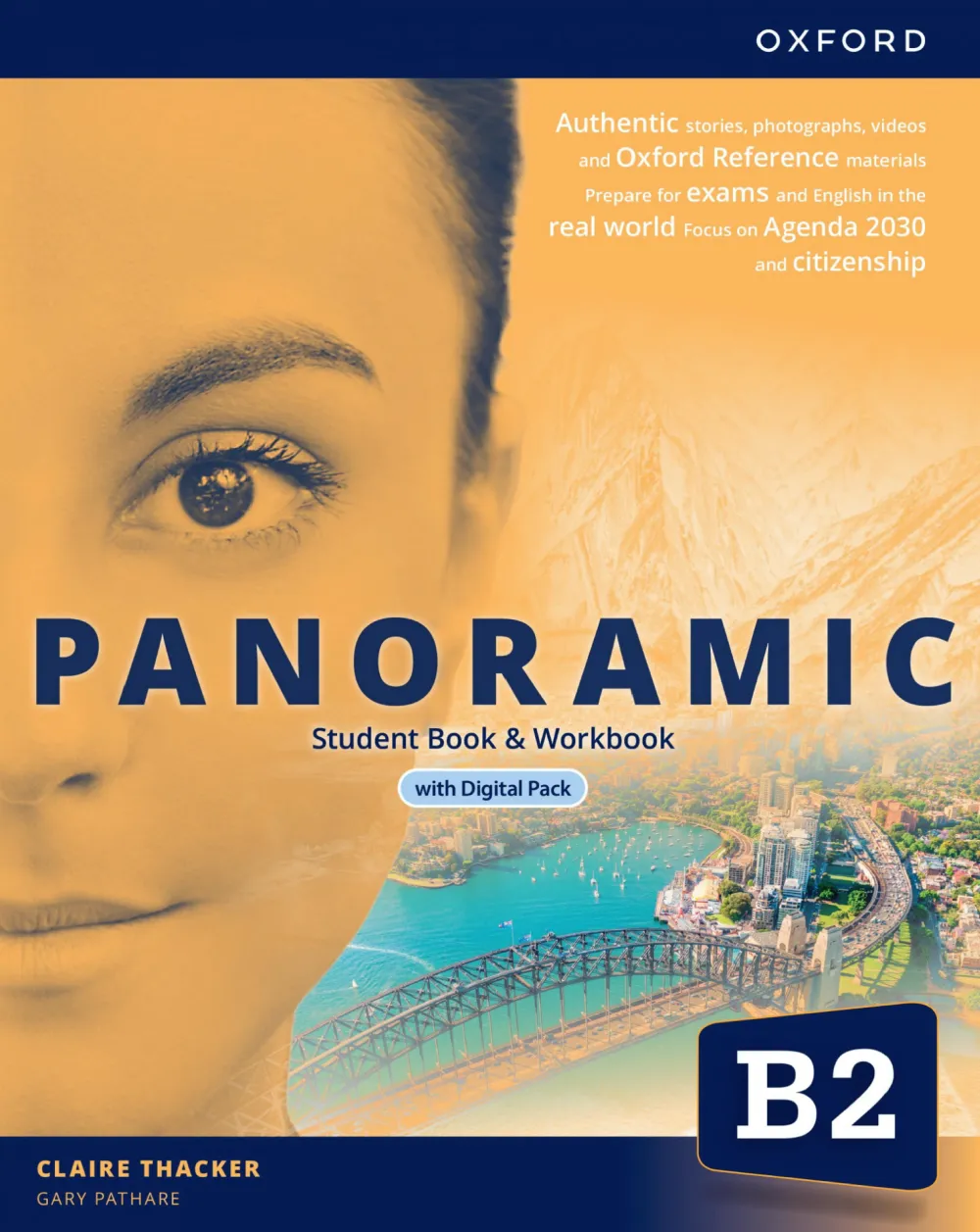
Panoramic B2 Student Book & Workbook
Support for Different Learning Needs
A modern course must recognize that students do not all learn in the same way or at the same speed. Panoramic provides structured support, recycling, review, and varied activity types to help teachers work with mixed-ability classes.
Where available, the Panoramic for All companion provides visual mind maps and additional support linked to the main course content. It was created with dyslexic learners in mind but can also benefit students who respond well to visual organization and concise summaries.
Such resources can reduce cognitive overload, clarify relationships between language points, and help learners see the overall structure of a unit more easily.
Panoramic Levels and Learning Progression
Panoramic A2
At A2 level, students strengthen their ability to communicate in familiar everyday situations. They develop essential grammar and high-frequency vocabulary while learning to understand straightforward texts and conversations.
Learners become more confident when describing people and places, discussing routines, sharing personal experiences, making arrangements, and communicating basic needs. The level establishes a reliable foundation for more independent language use.
Panoramic B1
At B1 level, students move toward greater independence. They learn to understand the main ideas of more substantial texts, follow conversations on familiar subjects, and express connected opinions with supporting reasons.
Grammar and vocabulary become more varied, while speaking and writing tasks require clearer organization. Students also engage more deeply with mediation, discussion, and skills relevant to academic study and external examinations.
Panoramic B2
At B2 level, learners work with more complex language and ideas. They practise understanding detailed arguments, evaluating viewpoints, discussing less familiar topics, and producing clear, well-developed spoken and written responses.
The course helps students improve precision, flexibility, and control while preparing them for upper-secondary examinations, further study, and situations in which English must be used with greater independence.
Who Is Panoramic Suitable For?
Panoramic is particularly suitable for:
- upper-secondary students studying English at A2, B1, or B2 level;
- teenagers who need a structured pathway from elementary to upper-intermediate English;
- schools seeking a CEFR-aligned course with contemporary educational content;
- language centers combining general English with examination preparation;
- teachers who want systematic grammar alongside meaningful communication;
- learners developing English for future study, work, and international interaction.
The series is most effective when used as part of a guided course, although its e-books, online practice, audio, video, and review materials may also support independent study.
Why Teachers May Choose Panoramic
For teachers, the main advantage of Panoramic is its balance. It combines the dependable structure expected from an Oxford course with themes and competencies that reflect contemporary education.
Teachers receive a clear progression of grammar, vocabulary, skills, and learning outcomes, but they also have opportunities to organize discussion, collaboration, mediation, critical thinking, and extended communication.
The course can therefore serve several objectives within the same program:
- building accurate language knowledge;
- improving communicative confidence;
- preparing students for assessments;
- developing academic and transferable skills;
- encouraging independent learning;
- connecting English with wider social and global themes.
Why Panoramic Stands Out
Many English courses claim to prepare students for the future. Panoramic gives this idea a practical educational structure. Its CEFR-aligned syllabus provides measurable language progression, while its topics, mediation work, and transferable skills extend learning beyond traditional exercises.
Its most notable strengths include:
- a clear three-level progression from A2 to B2;
- grammar aligned with the Oxford English Learning Framework;
- high-value vocabulary informed by the Oxford 3000 and Oxford 5000;
- integrated reading, listening, speaking, and writing development;
- contemporary topics that invite discussion and reflection;
- a strong focus on mediation and real-world communication;
- transferable skills for study, work, and life;
- exam-oriented practice within a complete language course;
- digital learning resources through Oxford English Hub;
- additional visual support for different learning needs.
Frequently Asked Questions About Panoramic
What CEFR levels does Panoramic cover?
Panoramic covers three CEFR levels: A2, B1, and B2. The sequence takes learners from elementary through intermediate to upper-intermediate English.
Is Panoramic suitable for secondary-school students?
Yes. The course is primarily designed for teenage and upper-secondary learners. Its topics, visual presentation, academic preparation, and communication tasks are appropriate for this age group.
Does Panoramic teach all four English skills?
Yes. The series integrates reading, listening, speaking, and writing with grammar, vocabulary, pronunciation, mediation, and transferable skills.
Can Panoramic help students prepare for English examinations?
Yes. It includes structured language and skills development relevant to school and external examinations. The exact assessment materials and exam coverage may vary according to the level, package, and regional edition.
Does Panoramic include digital resources?
Digital Pack editions may provide e-books, online practice, audio, video, and additional student resources through Oxford English Hub. Access conditions depend on the product package purchased.
Can Panoramic be used for self-study?
Its digital resources and practice materials can support independent learning. However, students are likely to gain the greatest benefit when the course is combined with teacher guidance, classroom interaction, feedback, and collaborative activities.
Conclusion
Panoramic by Oxford University Press is a thoughtfully structured English course for learners progressing from A2 to B2. It combines systematic grammar and vocabulary development with meaningful topics, integrated skills, mediation, exam preparation, digital practice, and competencies that students can transfer to other areas of education and life.
Its educational value lies in the way these elements work together. Students build accurate language knowledge, but they also learn to interpret information, communicate viewpoints, collaborate with others, and approach subjects from different perspectives.
For schools, teachers, and language centers seeking a modern Oxford course that balances academic rigor with genuine student engagement, Panoramic offers a strong and future-oriented learning pathway.